

48kWh Sigenergy Battery Installation in Richmond, Melbourne
How we installed one of Melbourne’s largest residential Sigenergy battery systems, and why this Richmond homeowner chose 48kWh of storage with a three-phase hybrid inverter for full energy independence.
The Brief: Full Energy Independence for a Three-Phase Richmond Home
When our client in Richmond first reached out to Carlin Co Electrical, they had a clear objective: stop paying peak electricity rates and gain genuine backup power for their family home. Like many properties in Melbourne’s inner east, their house runs on three-phase power, which complicates the battery equation considerably. Most residential batteries on the Australian market are designed for single-phase homes. Connecting a single-phase battery to a three-phase property means energy generated on one phase can’t offset consumption on the others, leaving money on the table every billing cycle.
After reviewing their energy usage data, the home’s existing solar system, and their long-term goals, we recommended the Sigenergy SigenStor system configured with 48kWh of usable storage and a three-phase hybrid inverter. It was the right tool for the job, and the result speaks for itself.
Why Sigenergy? A Premium Battery System Built for Australian Homes
Sigenergy is a name that’s gaining serious momentum in the Australian energy storage market, and for good reason. While brands like Tesla Powerwall and BYD have dominated the conversation for years, Sigenergy brings a different philosophy to the table: a fully integrated, ground-up approach where the inverter and battery are designed as one system rather than bolted together from separate product lines.
For this Richmond installation, several factors made Sigenergy the standout choice over competing systems.
True Three-Phase Balancing
The Sigenergy three-phase inverter doesn’t just connect to three-phase supply. It actively balances energy across all three phases in real time. In a typical Melbourne home with three-phase power, your oven might draw from Phase A, your air conditioning from Phase B, and your EV charger from Phase C. The Sigenergy system sees the whole picture and distributes stored energy where it’s needed most, maximising self-consumption rather than pushing excess back to the grid at low feed-in rates.
Modular, Stackable Capacity
The Sigenergy battery uses a modular architecture. Rather than purchasing a single monolithic unit, you stack battery modules to reach your target capacity. Our Richmond client opted for the full 48kWh configuration, which provides enough stored energy to comfortably power their home through two to three days of typical use without any solar input at all. This modularity also means homeowners can start smaller and expand later as their needs grow or electricity prices rise.
Integrated Hybrid Inverter
One of Sigenergy’s key advantages over competitors like BYD (which requires a separate third-party inverter) is that the inverter and battery management system are designed together. This reduces points of failure, simplifies the installation, and allows tighter integration between solar generation, battery storage, and grid interaction. For Richmond homeowners considering a battery, fewer components means fewer things that can go wrong over a 15-year product life.
Technical Specifications: What We Installed
| Specification | Details |
|---|---|
| Battery System | Sigenergy SigenStor |
| Usable Capacity | 48kWh |
| Inverter | Sigenergy three-phase hybrid inverter |
| Phase Configuration | Three-phase (balanced across all phases) |
| Backup Power | Yes, with configurable essential load circuits |
| Solar Compatibility | Hybrid (manages both solar input and battery simultaneously) |
| Monitoring | Real-time app monitoring with per-phase visibility |
| Battery Chemistry | Lithium iron phosphate (LFP) |
| Warranty | 10 years |
| Mounting | Exterior wall-mounted |
| Location | Richmond, Melbourne VIC |
| Installer | Carlin Co Electrical (CEC-accredited) |
The Installation Process: Three-Phase Done Right
Installing a 48kWh battery on a three-phase residential property is not a weekend job. It requires precise electrical planning, compliance with Australian standards, and an installer who genuinely understands three-phase power distribution. Here’s how we approached this project in Richmond.
Site Assessment and Design
Before any hardware arrived, we conducted a thorough assessment of the property’s existing electrical infrastructure: the switchboard configuration, current solar setup, cabling capacity, and the physical mounting location. Three-phase installations require careful load analysis across all phases to ensure the inverter is configured correctly from day one. We also assessed the wall structure for the exterior mount, ensuring it could support the weight of the full 48kWh battery stack.
Switchboard Upgrade
The existing switchboard needed modification to accommodate the hybrid inverter’s integration with three-phase supply. This included installing new circuit breakers, configuring the backup power changeover, and ensuring the metering was set up for the energy retailer. Switchboard work is one of the areas where cutting corners causes problems years down the line, so we take our time to get it right.
Battery Mounting and Cabling
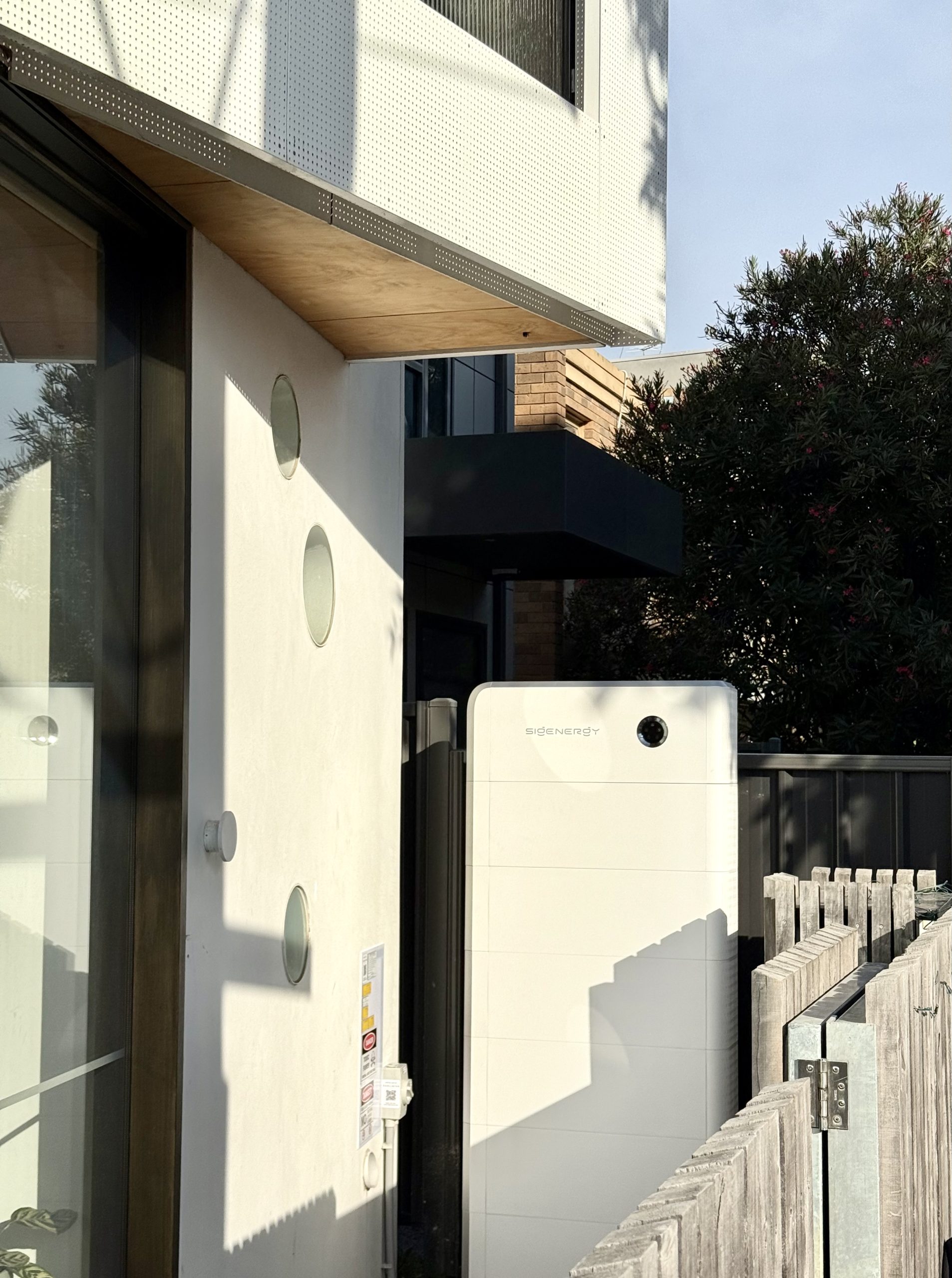
The Sigenergy unit was wall-mounted on the home’s exterior, positioned beside a timber fence in a location that balances accessibility for maintenance with clean visual integration. The white casing blends naturally with the modern facade. All DC and AC cabling was run through conduit to protect against Melbourne’s weather, with particular attention to cable sizing for the high-capacity system.
Commissioning and Handover
Once physically installed, we commissioned the system through the Sigenergy platform, configured the three-phase balancing parameters, set up the homeowner’s monitoring app, and programmed the backup power priorities. The client can now see exactly how much energy each phase is consuming, how much their solar is generating, and how their battery state-of-charge changes throughout the day, all from their phone.
Battery storage systems involve high-voltage DC power and complex integration with both your solar array and the grid. CEC-accredited installers like Carlin Co Electrical are trained, assessed, and held to ongoing standards by the Clean Energy Council. This accreditation is required to access government rebates and ensures your installation meets Australian electrical safety standards. Learn more about our accreditation.
Energy Savings and ROI: What 48kWh of Storage Delivers
The financial case for a home battery system in Melbourne has never been stronger, and a 48kWh system takes it to another level. Here’s the realistic picture for this Richmond household.
Near-Total Grid Independence
With 48kWh of storage paired with their existing solar system, our client can store virtually all of their daytime solar generation and use it through the evening peak period and overnight. On most days between September and April, they’ll draw almost nothing from the grid. Even in Melbourne’s shorter winter days, the battery provides a substantial buffer that dramatically reduces grid reliance.
Peak Rate Arbitrage
Melbourne’s time-of-use electricity tariffs charge significantly more during peak periods (typically 3pm to 9pm on weekdays). By charging the battery with free solar energy during the day and discharging during peak periods, the homeowner avoids the most expensive electricity rates entirely. On a typical plan, that’s the difference between paying 35 to 45 cents per kWh versus effectively paying nothing.
Projected Annual Savings
Based on the household’s consumption profile and solar generation data, we project annual electricity savings of approximately $4,000 to $5,500. This accounts for seasonal variation, realistic self-consumption rates, and a conservative estimate for any remaining grid draw. With electricity prices continuing to rise across Victoria, these savings are likely to increase year on year.
Blackout Protection
Beyond the dollar figures, there’s a practical value that’s harder to quantify: the peace of mind that comes with backup power. With 48kWh of stored energy, this Richmond home can ride out extended grid outages without disruption. The Sigenergy system automatically switches to backup mode within milliseconds, keeping essential circuits running. In a city where summer storms and infrastructure strain are becoming more common, that’s a meaningful benefit.
Considering Battery Storage for Your Home?
We design and install battery systems tailored to your home’s phase configuration, energy usage, and goals. No generic quotes. No hard sell.
Get a Free Quote
Or call us directly: 0432 632 346
Sigenergy vs Other Battery Systems: Where It Sits in the Market
Homeowners researching the best home battery system in Melbourne will inevitably compare Sigenergy against the more established names. Here’s honest context on where it fits.
Tesla Powerwall 3 remains the most recognised brand in Australian home batteries. It’s a solid, well-proven product with excellent software integration. However, the Powerwall 3’s single-unit capacity of 13.5kWh means you’d need multiple units to reach 48kWh, adding complexity and cost. Its three-phase support is also more limited than Sigenergy’s native implementation.
BYD HVS/HVM systems offer competitive pricing and modular capacity similar to Sigenergy. The key difference is that BYD batteries require a separate compatible inverter (typically Fronius or SMA), which adds another layer of integration and another warranty to manage. Sigenergy’s all-in-one approach simplifies the system architecture.
For a three-phase Melbourne home requiring 40kWh or more of storage, Sigenergy currently offers arguably the most elegant solution available in Australia: native three-phase balancing, modular scalability to 48kWh and beyond, and a single-vendor system with integrated hybrid inverter. That’s exactly why we recommended it for this Richmond project.
Why This Project Represents the Future of Home Energy in Melbourne
This Richmond installation isn’t just a case study. It’s a glimpse of where residential energy is heading in Melbourne’s inner suburbs. The combination of high-capacity battery storage, three-phase integration, and intelligent energy management transforms a home from a passive energy consumer into something much closer to a self-sustaining micro-grid.
As EV charger installations become standard, as electricity prices continue their upward trajectory, and as Victoria’s grid faces increasing pressure during peak periods, homes with systems like this will be insulated from the worst of it. They’ll charge their cars from their rooftops, run their air conditioning from their batteries, and experience blackouts as minor inconveniences rather than household emergencies.
At Carlin Co Electrical, we’re seeing this shift accelerate across Melbourne’s inner east. More homeowners in Richmond, South Yarra, Hawthorn, and surrounding suburbs are making the move to serious battery storage. Not the token 5kWh units of a few years ago, but genuinely large systems that change how a household interacts with energy.
Frequently Asked Questions: Sigenergy Batteries in Melbourne
How much does a 48kWh battery cost in Melbourne?
A 48kWh home battery system in Melbourne typically costs between $38,000 and $55,000 fully installed, depending on the brand, inverter configuration, and complexity of the installation. Sigenergy systems sit in the premium tier but offer excellent value given their integrated hybrid inverter, modular scalability, and backup power capabilities. The exact price for your home depends on factors like your existing switchboard, phase configuration, and mounting requirements. Call us on 0432 632 346 for an accurate quote tailored to your property.
What is the best home battery system in Melbourne in 2026?
The best home battery system depends on your household’s specific energy profile, phase configuration, and goals. In 2026, Sigenergy has emerged as a standout choice for Australian homes, particularly for three-phase properties where its native phase-balancing capability gives it a clear edge. For single-phase homes with more modest storage needs, Tesla Powerwall 3 and BYD HVS remain strong options. For larger three-phase homes, Sigenergy’s integrated hybrid inverter and modular capacity up to 48kWh and beyond make it hard to look past.
Is Sigenergy available in Australia?
Yes. Sigenergy products are available in Australia through CEC-accredited installers. Carlin Co Electrical is a certified Sigenergy installer servicing Melbourne’s inner suburbs, including Richmond, South Yarra, Hawthorn, Collingwood, Fitzroy, Prahran, and surrounding areas. Learn more about our team and accreditations.
How long does a 48kWh battery last during a blackout?
A fully charged 48kWh battery can power an average Melbourne household for approximately two to three days during a blackout, assuming typical daily consumption of 15 to 25kWh. Actual duration depends on which loads are running, whether solar is generating during the outage, and how the backup circuits are configured. The Sigenergy system allows you to prioritise essential circuits so critical loads like fridges, lighting, and internet stay on longest.
Do I need three-phase power for a Sigenergy battery?
No, Sigenergy systems are available in both single-phase and three-phase configurations. However, if your home already runs on three-phase power, a three-phase Sigenergy inverter is the ideal match. It balances energy across all three phases, which reduces grid export waste and maximises self-consumption. Most larger homes in Melbourne’s inner suburbs, including many in Richmond, already have three-phase supply. Not sure what your home runs? Give us a call and we can help you check.
How much can I save with a 48kWh home battery in Melbourne?
With a 48kWh battery paired with a well-sized solar system, most Melbourne households can reduce their electricity bills by 70% to 90%. On a typical time-of-use tariff, you store cheap solar energy during the day and use it during expensive peak periods in the evening. Annual savings of $3,000 to $5,500 or more are realistic for homes with significant daytime solar generation and high evening consumption. As Victorian electricity prices continue rising, these savings compound over the system’s 10+ year lifespan.
Ready to Explore Battery Storage?
Whether you’re looking at Sigenergy, Tesla, or just want honest advice on what makes sense for your home, we’re here to help. No obligation, no pressure.
Request a Quote
Prefer to talk? Call 0432 632 346
Related Services
Need an Electrician in Melbourne?
Carlin Co Electrical services all of Melbourne with licensed, insured electricians.
Get a Free QuoteOur ServicesNeed a licensed Melbourne electrician?
Carlin Co Electrical - trusted by Melbourne homes and businesses.
Book Your Electrician Call 0432 632 346